


















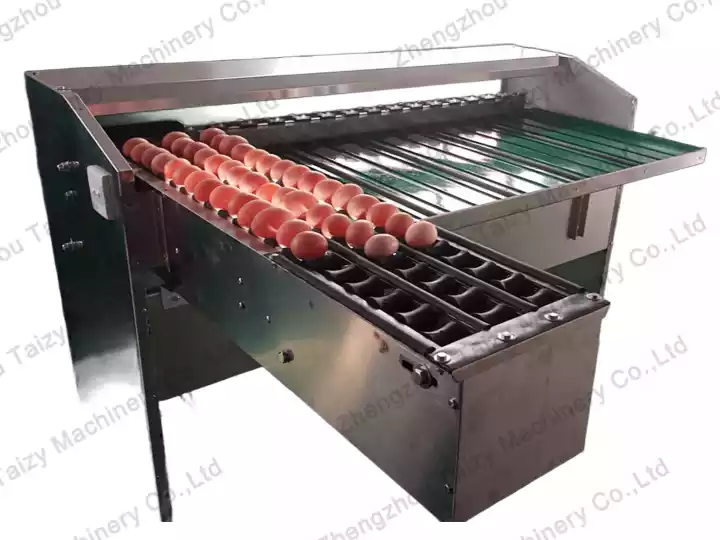
The automatic egg grading machine utilizes high-precision weighing sensors and light transmission detection technology to rapidly and accurately grade eggs by size, weight, color, and damage condition. It achieves a processing capacity of 2,000 to 10,000 eggs per hour (customizable to meet customer requirements).
This equipment supports multiple models and is suitable for grading various egg types, including chicken eggs, duck eggs, goose eggs, salted eggs, and preserved eggs.
Employing gentle conveying and delicate handling methods, it effectively reduces egg breakage rates while saving labor and improving production efficiency. It provides an ideal grading solution for small and medium-sized farms as well as large processing enterprises.
Egg grading machine application scenarios
- Egg farms: small to large-scale poultry operations including chicken, duck, and goose farms, enabling automated egg grading to reduce manual intervention.
- Egg processing plants: used for grading and sorting eggs, preserved eggs, century eggs, and other egg products to enhance processing efficiency and product consistency.
- Supermarkets and retail: enables grading and packaging in large supermarkets and egg wholesale centers, ensuring uniform product specifications for sale.
- Egg processing enterprises: used in factories producing cakes, mooncakes, egg-based snacks, and frozen egg products to ensure consistency in raw eggs.
- Hatcheries: some hatcheries utilize graders for egg pre-treatment, improving hatch rates and management efficiency.

Automatic egg grading equipment features
- High automation: fully automated grading throughout the process reduces manual labor and boosts production efficiency.
- Precise grading: utilizes high-precision weight sensors and optical detection for superior grading accuracy, with customizable 5 and 7 grade standards.
- Gentle handling: utilizes knife-type conveyors and link-type weighing principles to minimize eggshell breakage and preserve egg quality.
- Durable materials: constructed from carbon steel or stainless steel for corrosion resistance, durability, and extended service life.
- Easy maintenance: rational design facilitates cleaning and upkeep, reducing maintenance costs.
- Multi-functional expansion: integrates with egg washers, coders, and other equipment to form a complete egg processing line.

Working process of automatic egg grader
- Feeding conveyor: operators place eggs onto automatic trays or conveyor belts, preventing slippage and breakage.
- Light inspection: transilluminators assess internal shell quality, rejecting defective eggs including cracked, fertilized, moldy, or blackened specimens.
- Weight grading: qualified eggs undergo weighing and a preset grading system, automatically sorting into different channels based on weight and size to complete classification.
- Collection and output: graded eggs are collected by operators or automatic trays for convenient packaging and transportation.

How to choose the right egg sorting machine?
Before purchasing an egg grading machine, it is crucial to clearly define your production requirements and usage scenarios. Different scales and types of farms and processing enterprises have varying demands for grading speed, accuracy, and automation levels. Below are several core factors that must be prioritized during selection:
Define daily output and grading speed requirements
Egg grading machines typically operate at capacities ranging from 2,000 to 10,000 eggs per hour.
- Small family farms: opt for compact models with 2,000–4,000 eggs/hour capacity.
- Medium-sized farms: standard equipment handling 5,000–7,000 eggs/hour is recommended.
- Large egg processing plants: opt for high-efficiency models handling 8,000–10,000 eggs per hour.
Determine required grading levels
- Grading level requirements vary by application:
- General retail: 5 grades suffice.
- Supermarkets & food processing plants: require 5 or 7 grades to ensure product uniformity.
- Premium or export eggs: opt for 7 grades of high-precision grading.
Egg type and compatibility
Select corresponding structures and tray dimensions based on egg type:
- Chicken eggs → standard models suffice
- Duck/goose eggs → requires wider tray spacing and reinforced support structures
- Preserved eggs/salted eggs → requires gentler conveying methods

Egg sorter machine specifications comparison
| Parameter | 5-Grade Egg Grader (5400 eggs/hour) | 7-Grade Egg Grader (3700 eggs/hour) |
|---|---|---|
| Capacity | 5400 eggs/hour | 3700 eggs/hour |
| Number of Grades | 5 grades | 7 grades |
| Egg Feeding Rows | 3 rows | 2 rows |
| Material | 304 Stainless Steel | 304 Stainless Steel |
| Machine Dimensions | 1400 × 1600 × 1000 mm | 1400 × 1600 × 1000 mm |
| Voltage | 220 V | 220 V |
| Power | 120 W | 120 W |
| Packing Size | 1700 × 700 × 1200 mm | 1700 × 700 × 1200 mm |
| Weight | 170 kg | 160 kg |

Egg processing line combination solutions
Egg grading machines can operate independently or seamlessly integrate with egg washers, dryers, coders, tray packers, and other equipment to form fully automated egg processing lines.
Through assembly-line coordinated operations, these systems enable continuous processing flows—washing → drying → candling → grading → coding → packaging—significantly boosting production efficiency.
This integrated solution offers flexible configuration options tailored to the scale of individual farms or processing plants, helping businesses reduce labor costs while enhancing product consistency and market competitiveness.
Investing in our egg grading machine means your farm or business can achieve faster, more precise, and safer egg processing. Contact us today to find the model best suited for your operations and reduce your production and processing costs!